
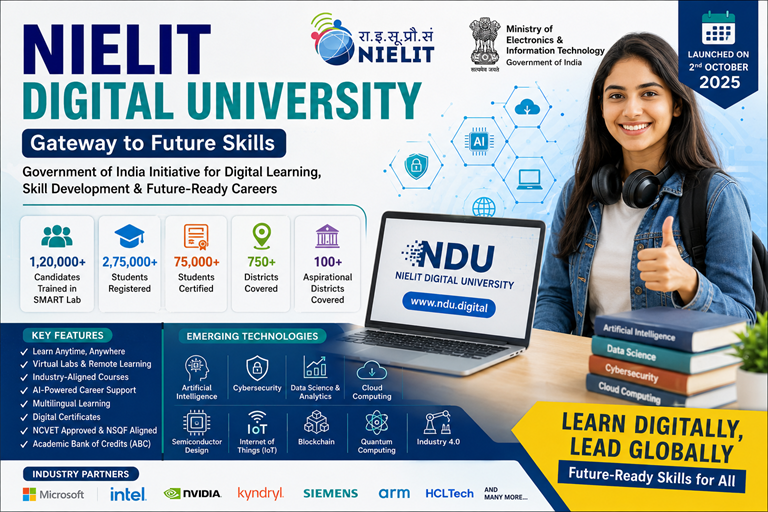
NIELIT Digital University
NIELIT Digital University 2026: Courses, Eligibility, Registration, Features & Career Opportunities
Description: Explore NIELIT Digital University, its courses, emerging technology programmes, virtual labs, certifications, industry partnerships, eligibility, registration process and career opportunities.
Introduction: Why NIELIT Digital University Matters
India’s education and employment landscape is changing faster than ever. A degree that was considered highly valuable a decade ago may no longer be enough to secure a strong career unless it is supported by practical, technology-oriented skills.
Artificial Intelligence, cybersecurity, cloud computing, data analytics, semiconductor design, Internet of Things, quantum computing and other emerging technologies are rapidly becoming part of everyday business. At the same time, many students and working professionals living outside India’s major metropolitan cities still face difficulties accessing specialised technology education.
This is the gap that the NIELIT Digital University (NDU) is designed to address.
Launched on 2 October 2025 in New Delhi by Union Minister Ashwini Vaishnaw, the NIELIT Digital University platform was created with the broader objective of making high-quality digital education more accessible, flexible, industry-oriented and employment-focused. The platform is being developed around emerging technology areas such as Artificial Intelligence, Cybersecurity, Data Science, Semiconductors and allied domains.
Unlike the traditional idea of a university where students necessarily have to attend a physical campus every day, NDU is designed around digital learning, flexible access, virtual laboratories, industry participation, multilingual content and technology-enabled career support.
For a student in a Tier-2 or Tier-3 city, a working professional looking to reskill, or a job seeker trying to move into the technology sector, this approach could be particularly important.
But what exactly is NIELIT Digital University? What courses does it offer? Who can benefit from it? Is it free? Does every course provide a government certificate? How does registration work? And can completing an NDU course actually help with employment?
This detailed guide answers these questions in simple language.

What is NIELIT Digital University?
NIELIT Digital University is a digital education and skilling ecosystem developed by the National Institute of Electronics and Information Technology (NIELIT), an autonomous scientific society under the Ministry of Electronics and Information Technology (MeitY), Government of India.
The platform was officially launched on 2 October 2025 with a vision of creating an inclusive, affordable, employment-oriented and technology-driven learning ecosystem.
The Government’s stated objective is not simply to create another online course website. Instead, NDU is intended to connect several components of modern education: learning content, practical exposure, virtual laboratories, industry requirements, certifications, career guidance and employment pathways.
The platform is aligned with broader national objectives including Digital India, the National Education Policy 2020 and Skill India. Government information says the platform is intended to support programmes in areas including Artificial Intelligence, Semiconductors, Cybersecurity and Cloud Computing, while providing features such as virtual labs, multilingual learning, industry-integrated courses and digitally verifiable certificates.
NIELIT Digital University Launch Date
The NIELIT Digital University platform was launched on 2 October 2025 in New Delhi.
The launch was conducted by Union Minister for Electronics and Information Technology Ashwini Vaishnaw. The launch event also included discussions on the role of Artificial Intelligence in education and industry-academia collaboration.
Five new NIELIT Centres were also virtually inaugurated during the same event at Muzaffarpur in Bihar, Balasore in Odisha, Tirupati in Andhra Pradesh, Daman and Lunglei in Mizoram.
The Main Objective of NIELIT Digital University
The simplest way to understand NDU is to think of it as an attempt to bring future-oriented technology education closer to learners, regardless of their location.
India has a huge population of young people, but opportunities for advanced technology education are not evenly distributed. Students living in large cities may have access to universities, technology companies, training institutes, laboratories and industry mentors. Someone living in a smaller town or remote district may not have the same opportunities.
NDU aims to reduce this geographical disadvantage.
Its broader objectives include:
- Making advanced digital education more accessible.
- Providing learning opportunities in emerging technologies.
- Connecting education with industry requirements.
- Providing practical learning through virtual laboratories.
- Supporting flexible online and blended learning.
- Providing multilingual learning opportunities.
- Creating pathways from learning to employment.
- Supporting continuous learning and reskilling.
- Providing verifiable digital certificates.
- Promoting technology education in underserved regions.
What Makes NIELIT Digital University Different?

There are thousands of online learning platforms available today. Therefore, a natural question is: why should a learner pay attention to NIELIT Digital University?
The answer lies in the combination of government-backed institutional infrastructure, industry alignment, practical learning and national reach.
NIELIT already has a large national network. At the time of the NDU launch, the Government stated that NIELIT had 56 centres, more than 750 accredited institutes and over 9,000 facilitation centres. NIELIT has also trained and certified millions of learners in information, electronics and communication technology-related areas.
NDU therefore builds upon an existing national skilling ecosystem rather than starting from zero.
Key Features of NIELIT Digital University
1. Learning Anytime and Anywhere
One of the biggest advantages of a digital learning platform is flexibility.
A college student can study after classes. A working professional can learn after office hours. A job seeker can use the platform to build additional skills without immediately leaving an existing job.
This flexibility is especially relevant for learners who cannot relocate to a major city for a specialised course.
2. Focus on Emerging Technologies
NDU focuses strongly on areas expected to influence future employment and industrial growth.
These include:
- Artificial Intelligence
- Machine Learning
- Cybersecurity
- Data Analytics and Data Science
- Cloud Computing
- Semiconductor Design
- Internet of Things
- Blockchain
- Industry 4.0
- Quantum Computing
- Programming and software technologies
The exact course catalogue can change as new programmes are introduced, so candidates should always verify the current course list, eligibility, fees and batch dates on the official NIELIT/NDU platform before applying.
3. Virtual Laboratories
One of the most interesting features highlighted for NDU is the use of virtual laboratories.
Traditional practical education often requires expensive physical laboratories. This can make advanced technology education difficult to deliver everywhere.
Virtual laboratories can allow learners to experiment with tools and environments remotely. This is particularly useful for areas such as electronics, semiconductor design, programming, cybersecurity and other technology disciplines where practical exposure is essential.
The launch material supplied with this article highlights the SMART Lab and its large learner base as an example of NIELIT’s practical-learning infrastructure.
4. Industry-Integrated Learning
A major weakness of some educational programmes is the gap between what students learn and what employers actually need.
NDU attempts to address this through collaboration with industry and other organisations.
At the launch, the Government emphasised the importance of stronger industry-academia collaboration and stated that NIELIT should work towards aligning courses with the needs of industry.
The launch material also displayed several technology companies and organisations as industry partners, including names such as Intel, Microsoft, NVIDIA, Kyndryl, Siemens, ARM and others.
The important point for students is not simply the presence of a company logo. The real value will come from how these partnerships translate into curriculum design, practical projects, mentoring, assessments, internships and employment pathways.
5. AI-Powered Career Support
Another interesting element described in the launch material is the use of Artificial Intelligence for career support.
The platform is intended to use AI-enabled tools such as career pathways, mentors and interview simulators.
This is important because learning a technical subject is only one part of building a career.
A learner also needs to know:
- Which job roles match the acquired skills?
- What additional skills are required?
- How should a resume be prepared?
- What questions may be asked in an interview?
- Which skills should be developed next?
AI-assisted career tools can potentially help learners answer some of these questions in a structured manner.
6. Multilingual Learning
Language is one of the biggest barriers to technology education in India.
Many technically strong learners struggle because most advanced learning content is available primarily in English.
NDU has been designed with multilingual learning in mind. The Government’s launch information specifically highlights multilingual learning as one of the platform’s features.
This approach could be especially valuable for learners from smaller towns and regions where English may not be the primary language of education.
7. Digital Certificates
NDU is also designed to provide digitally verifiable certificates.
Digital certification can make it easier for learners to maintain and share evidence of their training.
However, students should understand an important point: not every online certificate has the same academic or employment value.
Before enrolling, candidates should check the exact certification authority, course recognition, assessment method, duration, accreditation and whether the programme is NSQF/NCVET aligned or otherwise formally recognised.
What Are the Major Technology Areas Covered?
NIELIT Digital University is focused on technology areas that are increasingly important to India’s digital economy.
Artificial Intelligence
Artificial Intelligence has become one of the most important technology areas in the world.
AI is being used in banking, healthcare, manufacturing, logistics, education, retail, cybersecurity, automotive industries and almost every other major sector.
For students, AI-related learning can open pathways towards roles such as AI developer, machine learning engineer, data analyst, AI-enabled business analyst and related positions, depending on qualification and practical capability.
Cybersecurity
As businesses become increasingly digital, protecting data, systems and networks becomes critical.
Cybersecurity education can cover areas such as network security, information security, threat detection, security operations and cyber-risk management.
Demand for cybersecurity professionals is expected to remain significant because cyber threats continue to evolve alongside technology.

Data Science and Data Analytics
Businesses generate huge volumes of data. The challenge is converting that data into useful information.
Data analytics skills can help professionals understand trends, measure performance, identify problems and support business decisions.
For non-technical professionals, data analytics can also be a useful career transition because analytical tools are increasingly used in finance, logistics, supply chain, sales, HR and operations.
Cloud Computing
Modern companies increasingly use cloud infrastructure for applications, storage, databases, analytics and business systems.
Cloud computing education can therefore be relevant for IT support professionals, developers, system administrators, cybersecurity professionals and technology managers.
Semiconductor Design
Semiconductors have become strategically important for India’s technology and manufacturing ambitions.
NDU’s focus on semiconductor-related skills is therefore particularly significant.
The supplied NDU launch material also highlights eChipHub, which is associated with chip design learning using open-source EDA tools and practical design-to-prototype learning.
For engineering students interested in electronics, VLSI, chip design and semiconductor careers, this can represent an interesting area for specialised skill development.
Internet of Things
The Internet of Things connects physical devices with software, networks and data.
IoT skills are relevant to smart manufacturing, automobiles, industrial automation, agriculture, healthcare, logistics and smart-city applications.
Blockchain
Blockchain technology is another emerging area covered within NIELIT’s broader technology ecosystem.
Although the hype surrounding blockchain has changed over the years, distributed ledger technology continues to have applications in selected areas such as digital assets, supply-chain traceability, identity systems and secure transactions.
Industry 4.0
Industry 4.0 combines technologies such as automation, IoT, data analytics, AI, robotics and connected manufacturing.
This area is particularly important for India’s automotive, electronics, engineering and manufacturing industries.
Quantum Computing
Quantum computing represents a more advanced and specialised area of technology.
It is not a conventional entry-level career skill for everyone, but introducing learners to emerging technologies such as quantum computing can help build awareness of future technology directions.
How NDU Can Help Students
For students, NDU can potentially provide a bridge between academic education and practical digital skills.
Consider a student who has completed graduation but does not have a strong technical profile. Instead of starting another full-time degree immediately, the student may be able to add a targeted technology certification or skill programme.
Similarly, an engineering student can use specialised learning to complement classroom education.
The most valuable approach is to avoid collecting certificates without developing actual skills.
A learner should ideally combine:
- Conceptual knowledge
- Practical assignments
- Projects
- Industry-relevant tools
- Communication skills
- Problem-solving ability
- Interview preparation
How NDU Can Help Working Professionals
Working professionals may actually be among the biggest beneficiaries of digital learning.
Imagine a logistics executive who has spent years working with warehouse operations. If that person learns data analytics, Power BI, automation, AI tools and supply-chain technology, the professional profile can become much stronger than simply having operational experience.
Similarly:
- An HR professional can learn HR analytics and AI tools.
- An accountant can learn data analytics and automation.
- A sales professional can learn CRM analytics and AI.
- A manufacturing professional can learn Industry 4.0 and IoT.
- A software professional can specialise in cybersecurity or cloud computing.
This is the real power of digital reskilling: technology does not necessarily require professionals to abandon their existing careers. It can be used to make existing expertise more valuable.
Who Should Consider NIELIT Digital University?
NDU may be relevant for a wide range of learners.
- School and college students interested in technology.
- Engineering students seeking additional practical skills.
- Graduates looking for employment-oriented technology training.
- Working professionals seeking career growth.
- Job seekers trying to transition into technology roles.
- Entrepreneurs who want to understand emerging technologies.
- Teachers and trainers looking to upgrade technical knowledge.
- Learners from Tier-2 and Tier-3 cities.
- Learners who cannot relocate for specialised training.
Is NIELIT Digital University Only for Computer Science Students?
No.
While computer science and IT students may find many courses directly relevant, emerging technology increasingly affects almost every profession.
An electronics engineer may benefit from semiconductor and embedded-systems learning. A mechanical engineer may benefit from Industry 4.0. A business graduate may benefit from data analytics. A logistics professional may benefit from AI, analytics and automation.
The key question should not be, “Is my degree in computer science?”
A better question is, “Which technology skills can make my existing education and experience more valuable?”
Eligibility for NIELIT Digital University Courses
There is no single eligibility criterion applicable to every programme on the NDU ecosystem.
Eligibility depends on the individual course.
Short-term beginner courses may have relatively simple eligibility requirements, while advanced programmes may require graduation, engineering qualifications, mathematics, programming knowledge or other prerequisites.
NIELIT’s broader course ecosystem demonstrates this variation. For example, its current training offerings include beginner and short-term programmes as well as advanced academic programmes.
Therefore, candidates should always check the eligibility criteria displayed for the specific programme before paying any fee.
Is NIELIT Digital University Free?
This is one of the most common questions.
The answer is: do not assume that every NDU programme is free.
Some government-supported training programmes or specific initiatives may be offered at subsidised or zero cost to eligible candidates, while other programmes may carry course, examination or certification fees.
NIELIT’s official course portals show that course fees and eligibility can vary significantly by programme.
Therefore, before registering, check:
- Course fee
- Examination fee
- Certification fee, if applicable
- Refund policy
- Eligibility
- Course duration
- Learning mode
- Assessment process
- Certificate details
Never rely only on a social media post claiming that a particular NIELIT course is “100% free” unless the offer can be verified through an official NIELIT or Government source.
How to Register for NIELIT Courses
The exact registration process can differ depending on the programme and portal.
NIELIT’s official online admission guidance generally requires candidates to register online, provide personal and qualification details, select the desired course, upload required documents and complete payment where applicable.
A typical process can be summarised as follows:
- Visit the official NIELIT/NDU portal.
- Create a new user account if required.
- Verify your mobile number or email, where applicable.
- Complete the candidate profile.
- Select the desired programme.
- Read eligibility and course requirements carefully.
- Check course duration and fee.
- Upload required documents.
- Pay the applicable fee through the official payment facility.
- Submit the application.
- Save the application number and payment receipt.
- Follow the instructions regarding classes, assessment and certification.
For certain NIELIT courses, the official student portal is used for registration, examination and related activities.
Documents That May Be Required
Documents depend on the course, but candidates may commonly be asked for:
- Passport-size photograph
- Identity proof
- Educational qualification certificates
- Category certificate, where applicable
- Signature
- Mobile number
- Email address
- Other course-specific documents
Candidates should upload only documents requested by the official portal and should avoid sharing sensitive documents through unofficial WhatsApp groups or unknown websites.
What Is the Role of NSQF and NCVET?
One of the more important aspects of the NDU vision is alignment with recognised skill-development frameworks.
The Government’s launch information states that the platform includes NCVET-approved and NSQF-aligned programmes, along with credit transfer through the Academic Bank of Credit for applicable programmes.
For students, this is important because a structured national skills framework can help provide consistency in qualifications and learning outcomes.
However, learners should still verify the exact status of the particular course they are considering. The recognition of one programme should not automatically be assumed for every programme available through the broader ecosystem.
Academic Bank of Credits and NDU
The Academic Bank of Credits, commonly known as ABC, is designed to facilitate the digital storage and transfer of academic credits in India’s higher-education ecosystem.
The NDU vision includes credit transfer through ABC for applicable programmes.
This could become especially useful for learners following flexible education pathways where learning may occur through different institutions or programmes.
Industry Partnerships: Why They Matter
The presence of industry collaboration is one of the strongest ideas behind NDU.
Technology changes much faster than traditional academic curricula. A university curriculum may take considerable time to be revised, while industry tools and job requirements can change within months.
Industry participation can help education providers understand:
- Which technologies are being adopted.
- Which skills employers are seeking.
- Which tools students should learn.
- Which practical projects are relevant.
- What skills are missing among fresh graduates.
At the NDU launch, the Government specifically highlighted the importance of working with major industry partners and aligning education with industrial requirements.
The launch also featured MoUs and collaborations involving organisations such as Microsoft, Zscaler, Dixon Technologies and others.
Smart Lab and Practical Learning
The NDU promotional material supplied for this article highlights the SMART Lab, describing it as a virtual prototyping and remote hardware learning facility.
This is significant because practical learning is one of the areas where online education often struggles.
Watching a video about electronics is different from actually designing, testing or troubleshooting something.
Virtual laboratories attempt to close that gap by allowing learners to interact with practical environments remotely.
The concept is especially relevant for learners who do not have access to expensive physical laboratories in their local institutions.

What Is eChipHub?
The supplied NDU promotional material also highlights eChipHub, with a focus on semiconductor and chip-design learning.
According to the material, the initiative is built around open-source Electronic Design Automation tools and supports a learning journey that moves from learning to design and prototype development.
This is strategically important because semiconductor design is becoming increasingly important for India’s electronics and technology ecosystem.
Students interested in VLSI, chip design, electronics engineering and semiconductor careers may therefore want to explore the relevant programmes and practical opportunities available through the NIELIT ecosystem.
Career Opportunities After NDU-Related Training
Completing a course does not automatically guarantee a job. However, acquiring relevant skills can improve a candidate’s employability.
Depending on the programme and the learner’s educational background, possible career directions may include:
- Data Analyst
- Junior Data Scientist
- AI/ML Trainee
- Cybersecurity Analyst
- Cloud Support Associate
- IT Support Specialist
- Software Developer
- IoT Technician or Developer
- Semiconductor/VLSI Trainee
- Electronics Design Professional
- Business Intelligence Analyst
- Automation Professional
- Technical Support Executive
The actual job role depends on the learner’s qualification, technical ability, project experience and communication skills.
Can an NDU Certificate Guarantee a Job?
No.
This point deserves special attention.
No legitimate educational platform should be treated as a guaranteed-job scheme merely because it is government-associated.
A certificate can demonstrate that a learner completed a programme. Employment decisions are generally based on a combination of qualifications, practical knowledge, experience, projects, communication skills, aptitude and interview performance.
The best strategy is therefore to treat an NDU course as a skill-building opportunity rather than a job guarantee.
How Freshers Should Use NDU Strategically
Freshers should avoid the temptation to register for ten unrelated certificates.
Instead, select one career direction.
For example:
Career Path 1: Data Analytics
Excel → SQL → Data Visualisation → Power BI → Python → Projects → Interview Preparation.
Career Path 2: Cybersecurity
Networking → Linux → Security Fundamentals → Security Tools → Practical Labs → Entry-Level Cybersecurity Roles.
Career Path 3: AI/ML
Python → Statistics → Machine Learning → AI Applications → Projects → Portfolio.
Career Path 4: Cloud Computing
Networking → Linux → Cloud Fundamentals → Cloud Platform → Deployment → Cloud Support/Engineering Roles.
Career Path 5: Semiconductor
Digital Electronics → Verilog/SystemVerilog → Digital Design → EDA Tools → VLSI/Chip Design Projects.
A focused learning pathway is normally more valuable than a collection of unrelated certificates.
How Working Professionals Can Use NDU
Working professionals should think differently from freshers.
You do not necessarily need to become a software engineer.
Instead, identify how technology can improve your existing profession.
For example, a warehouse manager could learn:
- Advanced Excel
- Power BI
- Data Analytics
- Warehouse automation
- AI productivity tools
- Supply-chain analytics
A finance professional could focus on analytics, automation and AI-assisted reporting.
A manufacturing professional could learn IoT, Industry 4.0, robotics and data analytics.
This combination of domain expertise plus digital capability can become a powerful career advantage.
NDU and Tier-2/Tier-3 Cities
One of the strongest social benefits of digital education is its ability to reduce geographical barriers.
India’s technology economy cannot depend only on talent from Bengaluru, Hyderabad, Pune, Chennai, Delhi-NCR or Mumbai.
There are talented students across smaller cities, towns and rural areas.
The Government has specifically described NDU as a platform intended to democratise access to high-quality digital education, including for learners in remote regions.
If the platform is implemented effectively, a student who previously had limited access to advanced technology training may be able to access structured learning without relocating immediately.
NDU and Women Learners
Digital education can also create opportunities for women who face restrictions related to travel, relocation or conventional classroom schedules.
Flexible learning allows learners to study around family responsibilities or employment.
However, digital access alone is not enough. Devices, reliable internet, mentorship, financial support and safe learning environments also matter.
The success of a digital university should therefore be measured not only by registrations, but by how many learners actually complete courses, acquire skills and progress towards meaningful education or employment outcomes.
Challenges NIELIT Digital University May Face
NDU has considerable potential, but it also faces real challenges.
Digital Divide
Online learning requires a reliable device, internet connection and basic digital literacy.
Students in remote areas may still struggle with these requirements.
Course Quality
Having a large number of courses is not enough. Courses must remain current and relevant to industry.
Practical Exposure
Virtual laboratories can help, but certain skills still benefit from physical equipment and supervised practical work.
Completion Rates
Online learning has historically faced a major challenge: people register but do not finish.
A successful platform must therefore focus on learner engagement, mentorship, assessments and completion.
Employment Outcomes
The ultimate test will be whether learners can convert training into better employment, entrepreneurship or career progression.
Awareness
Many students may still not know which government technology programmes are available or how they differ from commercial training platforms.
Career guidance will therefore be an important part of the ecosystem.
What Does the NDU Vision for 2030 Look Like?
The Government’s launch information states that NDU aims to reach 40 lakh learners by 2030.
That is an ambitious target.
Reaching such a large learner population will require more than an online portal. It will require strong course design, reliable technology, qualified trainers, industry participation, regional outreach, multilingual content and effective learner support.
If these components work together, NDU could become an important part of India’s future digital-skilling infrastructure.
How to Select the Right NIELIT Course
Before registering, ask yourself five questions:
- What job or career am I targeting?
- What skills does that career require?
- Does this course teach those skills?
- Will I get practical/project experience?
- Is the certificate appropriate for my career objective?
Do not choose a course merely because its title contains words such as “AI”, “Data Science” or “Cybersecurity”.
Read the syllabus.
Check the prerequisites.
Understand the assessment system.
Check the total fee.
Most importantly, determine whether the course fits your career plan.
NIELIT Digital University vs Traditional College
| Feature | NIELIT Digital University Approach | Traditional College |
|---|---|---|
| Learning | Digital/flexible learning | Primarily classroom-based |
| Location | Designed for wider geographic access | Usually campus-based |
| Emerging technologies | Strong emphasis | Depends on institution |
| Virtual labs | Important component | Physical labs generally used |
| Industry alignment | Core stated objective | Varies by institution |
| Learning flexibility | High for applicable programmes | Usually lower |
This does not mean NDU should replace universities or colleges.
In fact, the more useful way to look at it is as a complementary ecosystem for digital learning, skilling and reskilling.
NIELIT Digital University and the Future of Employment
The employment market is moving towards a combination of qualifications and demonstrable skills.
Employers increasingly want people who can solve problems rather than simply remember theoretical information.
This is why practical projects, portfolios, internships and real-world assignments are becoming increasingly important.
NDU’s industry orientation and virtual learning infrastructure are therefore potentially valuable.
But learners must also take responsibility.
A course cannot replace curiosity.
A certificate cannot replace practice.
And an online lecture cannot replace problem-solving.
The most successful learner will be the person who uses the platform as a starting point and then continues practising outside the classroom.
Important Advice Before Paying for Any NIELIT Course
Always verify the programme through the official NIELIT platform.
Do not pay money to an individual claiming to be a NIELIT representative unless the payment process is clearly authorised by the official portal.
Check the exact course name.
Check the institute or delivery partner.
Check the official fee.
Check the official admission deadline.
Check the certificate details.
Check the refund policy.
Government education initiatives are sometimes misused by unofficial websites to attract students. Candidates should therefore be particularly careful with websites promising guaranteed jobs, guaranteed salaries or certificates for unrealistic fees.
Official Sources for Verification
Readers should use official NIELIT and Government of India sources for the latest information because course lists, fees, eligibility requirements and admission dates may change.
NIELIT Official Website: https://www.nielit.gov.in/
NIELIT Student Portal: https://student.nielit.gov.in/
NIELIT Digital University: https://ndu.digital/
The Government of India’s official announcement confirms that the NDU platform was launched on 2 October 2025 and describes its focus on emerging technologies, virtual labs, industry-integrated programmes, multilingual learning, digital certificates and AI-enabled career support.
Frequently Asked Questions About NIELIT Digital University
What is NIELIT Digital University?
NIELIT Digital University is a digital learning and skilling platform developed by NIELIT under the Ministry of Electronics and Information Technology, Government of India, with a focus on emerging technologies and employment-oriented learning.
When was NIELIT Digital University launched?
The NIELIT Digital University platform was launched on 2 October 2025 in New Delhi.
Who launched NIELIT Digital University?
The platform was inaugurated by Union Minister Ashwini Vaishnaw during the national launch event in New Delhi.
What subjects are available through NDU?
The platform focuses on emerging areas such as Artificial Intelligence, Cybersecurity, Data Science, Semiconductors, Cloud Computing and allied technologies. The exact course catalogue should be checked on the official platform.
Is NIELIT Digital University free?
Not every programme should be assumed to be free. Fees depend on the specific programme and delivery arrangement. Candidates should verify the current official fee before registration.
Can working professionals join NDU programmes?
Many digital and short-term programmes can be useful for working professionals, subject to the individual course’s eligibility requirements.
Does NDU provide jobs?
NDU should not be treated as a guaranteed-job scheme. Training can improve skills and employability, but employment depends on qualifications, practical skills, experience, projects and employer selection.
Are NDU certificates recognised?
The recognition and certification status depends on the specific programme. Candidates should check whether the particular course is NCVET-approved, NSQF-aligned, academically recognised or otherwise certified before enrolling.
Can students from rural areas benefit?
Yes. Expanding access to learners beyond major cities and remote areas is one of the major objectives of the NDU platform.
Is NDU only for IT students?
No. Emerging technologies are relevant to engineering, manufacturing, finance, logistics, healthcare, business, education and many other sectors.
Final Verdict: Is NIELIT Digital University Worth Exploring?
Yes, NIELIT Digital University is worth exploring, particularly for learners who want to build skills in emerging technologies.
Its most important contribution may not be any single course. The bigger idea is the creation of an ecosystem that attempts to connect technology education, practical learning, industry requirements, digital certification and career development.
For India, this is important.
The country has a huge young population and a growing technology economy. The challenge is no longer simply producing graduates. The challenge is ensuring that graduates and working professionals have the skills required by the next generation of industries.
NDU is an attempt to address that challenge through digital access.
For students, the message is simple: do not collect certificates; build capabilities.
For working professionals: do not wait for your industry to change before you learn new technology.
For employers: participate in shaping the skills that the future workforce needs.
And for India: the real success of Digital University will ultimately be measured not by how many people register, but by how many people acquire useful skills, create opportunities and build better careers.
NIELIT Digital University therefore represents an important experiment in making advanced technology education more accessible and more closely connected with India’s employment and industrial needs.
Anyone interested in joining a programme should check the latest official NIELIT/NDU information before applying because course availability, fees, eligibility and admission schedules can change.
Last Updated: August 2026
Disclaimer
The information published in this article on MeriJobs.in is intended for general educational, informational and career-awareness purposes only. Although reasonable efforts have been made to compile the information from publicly available Government of India, NIELIT and other reliable sources, course availability, eligibility criteria, fees, admission dates, certification status, learning modes and other programme details may change from time to time. Readers are therefore strongly advised to verify all information directly through the official NIELIT website, NIELIT Digital University platform and applicable Government portals before registering, making any payment or taking an educational or career decision. MeriJobs.in is an independent information and career-content website and is not claiming to represent NIELIT, the Ministry of Electronics and Information Technology or the Government of India unless specifically stated. Mention of any organisation, technology company, course, platform or industry partner is provided for informational purposes and should not automatically be interpreted as an endorsement, sponsorship or guarantee. Completion of any NIELIT or NDU programme does not guarantee employment, salary, promotion, admission or any particular career outcome. Readers should independently assess whether a programme matches their educational background, career objectives and professional requirements. MeriJobs.in shall not be responsible for losses, damages, fees or decisions arising from reliance on outdated, incomplete or incorrectly interpreted information. Always use official portals for final verification and payments.
Recent Comments